Showing posts with label science. Show all posts

Wednesday, July 7, 2010

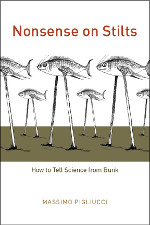
Book Review - Nonsense on Stilts

If you have been reading this blog for very long, it is probably clear that I'm an armchair science buff. In the grand scheme of life do-overs, I'd probably be a physicist or biochemist right now. So, I am a sucker for science-oriented books like Massimo Pigliucci's Nonsense on Stilts.


Nonsense on Stilts takes on the not-so-easy task of trying to lay out a set of standards that people can use to separate what is science and scientific from "almost science" and from pseudoscience and flat-out bunk. Given that major U.S. newspapers still carry astrology columns, most people cannot even explain what the theory of evolution actually is, and overall U.S. science literacy is poor, it is an exceptionally useful book that will probably never get read. After all, people are scientifically illiterate because they do not read about science, so it is unlikely that they will encounter (or consent to read) a book about what science really is.

As a relatively well-known skeptic, Pigliucci goes after his perceived opponents with quite a bit of energy. Folks who deny evolution, think autism is caused by vaccines, or deny climate change are likely to be offended by a fairly merciless assault on their viewpoints. Unfortunately, in my experience that is not really the best way to engage the sort of people that this book claims to target - you do not attract the ignorant and uninformed by going on at length about how ignorant and uninformed they are. I mean, hey, I know I'm fat -- but you're not going to sell me your fitness DVD by constantly telling me how bad I am for being fat.

Here too is a problem that is bigger than Nonsense on Stilts - unfortunately, books that talk about the primacy of science and the ignorance of those who do not embrace science are pretty much targeted and read by those who already agree. Since it is not too likely that those who reject or minimize science will read this book (or finish it if they start), it creates something of an echo chamber effect of preachers appealing to their own choir.

Nevertheless, I do admire the author for how he handles the "grey" areas of science with some finesse and compassion. I also appreciate that he does discuss some of the subjectivity that goes into the process and how the conception of science has changed a great deal over time - including how science used to be a part of philosophy. 

One of the weaker areas of the book is Pigliucci's discussion of the history of science. It is not so much that the author makes mistakes or handles this section poorly; rather, it is a very broad subject that has been addressed by other authors in other works (and addressed with a bit more depth and proficiency).

To his credit, the author finishes on a strong note, talking about how science has been misused and abused in the past and that total faith in science itself is actually a departure from what science is supposed to be. In other words, "trust, maybe, but always verify".

If you are not already interested in science, I am not sure how to convince you to read this book. As I said, this is a major failing of Nonsense on Stilts - if you are not already interested in science, or at least conditioned and inclined to accept it as significant and authoritative, this just will not appeal to you. On the other hand, if you do enjoy science and reading about it, this is a great book that I can highly recommend. After all, the more we know about science is conducted, disseminated, and exploited, the better for us all.

Wednesday, June 16, 2010

Book Review - The Science of Liberty

Every once in a while you find a book written by a clearly qualified writer addressing a pertinent and interesting topic. Unfortunately, some of the authors fall into what I call "Ayn Rand syndrome"; they think their ideas are so good, their topics so interesting and vital, that they must beat you over the head with them page after page after page.

That is perhaps the biggest failing in Timothy Ferris' work The Science of Liberty.


Even with that flaw, however, this is a book that is worth reading. The gist of the author's theme is that science has a long record of improving the quality of life for people around the world in a wide variety of ways. That's not exactly a revolutionary idea, but Ferris goes into detail attempting to show how progress in science has led to progress in government (towards democracy and freedom), progress in civics and ethics, and progress in commerce.

Ferris also draws many lines connecting science and liberalism. Here is one of the more valuable parts of the book in my view; the author goes to great lengths to try to recapture the original and true meaning of liberalism. What is commonly called "liberal" or "liberalism" in America is really more like progressivism and populism; you have to look more to modern Libertarian to come close to the original meaning of "liberalism".

Ferris does go a little too far in some cases, for instance he overestimates how accessible science is to everywhere. While I absolutely agree that anybody *can* learn science and become scientifically literate, once you abandon that path (usually early in life), it becomes exceptionally difficult to find it again later in life.

I imagine this book will not please the very religious, nor those highly skeptical of science and the scientific process. The author argues in several places that religion has been an impediment to progress, liberty, and ethics. Moreover, he is withering in his criticisms of those who would approach science as "just another point of view" or another way of experiencing the world. I can't say that I disagree with the author, but then I went into this work with a pro-science slant.

While I did enjoy this book, I can only give it a recommendation with some reserves. If you are already in the "pro-science" camp, this book will not do much more than make you feel even more justified and correct in your world view. Now, plenty of people like reading books that confirm their point of view, so this is certainly a good one for the pro-science crowd.

If you are more of a skeptic about science, though, or feel that religion and philosophy have a bigger role to play in improving people's quality of life, this will not be a pleasant book to read. Unfortunately, the author is also so heavy-handed and opinionated at times (the aforementioned Ayn Rand Syndrome) that you will feel more like you are being bullied and bludgeoned than presented with clear evidence and interpretations to change your mind.

(Apologies for the relatively low quality of the front cover scan)