It is certainly true that not all retail is the same and that has
been quite clear over the last six months in China's retail sector. Food
retailers like Sun Art (OTCPK:SURRY) and China Resources Enterprise (OTCPK:CRHKY) are struggling through weak same-store sales growth, but footwear and sportswear retailers like Belle (OTCPK:BELLY), Daphne (OTCPK:DPNEY), and ANTA Sports (OTCPK:ANPDY) are doing quite a bit better despite unimpressive same-store growth in the footwear business.
I have mixed feelings about Belle shares after this better than 10% move since my last update.
I think Belle has a very good business (six of the top ten women's
footwear brands in China and a long run of double-digit returns on
capital), but management still has a lot of work to do with its online
strategy. I'm also a little concerned about valuation, as the market
seems to already be pricing in at least 8% annual free cash flow growth
across the next decade.
Continue reading here:
Belle International Fairly Popular Despite Some Core Weakness

Showing posts with label Adidas. Show all posts
Showing posts with label Adidas. Show all posts
Tuesday, September 9, 2014


Wednesday, December 18, 2013
Seeking Alpha: China Dongxiang - A Sportswear Company That Doesn't Want To Make Sportswear
When you look overseas you often find some unusual, if not outright strange, stories. China Dongxiang Group (OTC:CDGXY)
(3818.HK) may just take the cake, as this sportswear company apparently
isn't very interested in being in the sportswear business.
Although China Dongxiang owns a relatively popular sportswear brand in China (Kappa), management no longer seems committed to building the brand. Instead, management likes to take the company's cash and invest in other companies and investment funds, most having little or nothing to do with sportswear. Apart from a small stake in Alibaba, management has shown no particular skill with these investments and it seems unlikely that they are going to pay out the surplus cash as a dividend or reinvest it into the business.
Read the full article here:
China Dongxiang - A Sportswear Company That Doesn't Want To Make Sportswear
Friday, June 28, 2013
Investopedia: Nike Stretches Its Lead
Chasing Nike (NYSE:NKE) in the footwear business has to be a frustrating exercise for the likes of Adidas (Nasdaq:ADDYY), Skechers (NYSE:SKX), and Puma.
In good times and bad, Nike's unmatched commitment to marketing and
product development translates into strong share, revenue, and profits.
Should Nike ever make a similar commitment to leading the apparel
market, who knows how much larger the company could get? In any case,
Nike doesn't look cheap today, but then it so seldom does.
A Solid End To The Year
Nike brought the fiscal year to a good end with fourth quarter results. Revenue rose more than 7% as reported, or about 9% on a constant currency basis. Growth was led by the tiny equipment business (up over 10%), while footwear sales rose almost 7% and apparel was up 6%. While the North American market has remained a hot one for Nike (up 12%), China has turned positive again.
Please read more on Nike here:
http://www.investopedia.com/stock-analysis/062813/nike-stretches-its-lead-nke-addyy-ua-lulu.aspx
Saturday, March 23, 2013
Investopedia: Nike Continues To Just Do It
For Nike (NYSE:NKE)
to perform as it has despite economic challenges in Europe, China, and
the U.S. is a pretty strong testament both to the power of the brand,
but also the company's commitment to product development. With a strong
pipeline, signs of improvement in China, and the potential to recapture
some lost gross margin,
Nike could retest its 52-week high in the not-so-distant future. Nike
isn't a terribly cheap or underrated stock, but strong financial
performance could still translate into decent (or better) stock
performance.
Click below to continue:
http://www.investopedia.com/stock-analysis/032213/nike-continues-just-do-it-nke-ua-dks-lulu-addyy.aspx
Click below to continue:
http://www.investopedia.com/stock-analysis/032213/nike-continues-just-do-it-nke-ua-dks-lulu-addyy.aspx
Monday, October 1, 2012
Investopedia: China Still A Pebble In Nike's Shoe
The investment community seems to have locked on to Nike's (NYSE:NKE)
"China problem," and this quarter's results aren't going to help. The
good news is that investors can still take advantage of this situation
to build a position in a stock that very rarely ever gets down to a fair
price, let alone cheap. The bad news, however, is that results could
slow in the interim and Wall Street is very much a "what have you done
for me lately?" sort of business.
To read more, please follow this link:
http://www.investopedia.com/
To read more, please follow this link:
http://www.investopedia.com/
Monday, May 2, 2011
Investopedia: Wooly And T-Dawg Go Gucci
Somehow it just does not seem too likely that Gucci's core customer base overlaps much with folks who call themselves "Wooly" and "T-Dawg", but France's PPR, which owns the esteemed Gucci label, is going to give it a go anyway. On Monday morning, the French holding company announced that it would be acquiring U.S. boardwear apparel maker Volcom (Nasdaq:VLCM), which was founded by the aforementioned Wooly and T-Dawg in 1991. (For background reading, see Using Consumer Spending As A Market Indicator.)
The Terms of the Deal
PPR is paying almost $608 million for the smaller clothing company, giving Volcom shareholders $24.50 a share in cash, or a 24% premium to Friday's close. That puts a valuation on Volcom shares of about 1.5x trailing sales and about 10.5x trailing EBITDA - not exactly premium pricing for a once-hot stock.
Read the full piece here:
http://stocks.investopedia.
The Terms of the Deal
PPR is paying almost $608 million for the smaller clothing company, giving Volcom shareholders $24.50 a share in cash, or a 24% premium to Friday's close. That puts a valuation on Volcom shares of about 1.5x trailing sales and about 10.5x trailing EBITDA - not exactly premium pricing for a once-hot stock.
Still, it is difficult to value a company like Volcom on a relative basis. Billabong is publicly listed in Australia and trades at an even lower valuation, Quicksilver (NYSE:ZQK) is struggling, and other once-popular boardwear companies like Vans and Ocean Pacific faded years ago and were acquired by the likes of VF Corp (NYSE:VFC) and Iconix (Nasdaq:ICON).
Read the full piece here:
http://stocks.investopedia.
Thursday, December 9, 2010
Lululemon Masters The Upward-Profits Pose
I am not aware of a "ring the cash register" pose in yoga, but if there is one, I have no doubt that Lululemon Athletica (Nasdaq:LULU) has mastered it. Combining a healthy living and pro-environment shtick with truly well-designed, well-crafted and well-marketed apparel, Lululemon is carving out a very successful niche in women's athletic apparel market and driving value-centered investors to distraction.
A Limber Third Quarter
It is a real challenge to find a metric in which Lululemon did not excel in its fiscal third quarter. Revenue jumped almost 56% to $176 million, leaving the highest published estimate in the dust. Likewise, comp-store sales growth of 29% was outstanding and the company produced an eye-popping amount of productivity (nearly $2,000 in sales per gross square foot of selling space, on an annualized basis). Sure, that's less than what, say, Tiffany (NYSE:TIF) does, but they sell diamonds! Compared to other clothing retailers, even solid performers like Urban Outfitters (Nasdaq:URBN) or Limited's (NYSE:LTD) Victoria's Secret cannot come close to that level of performance.
Please click below for the full article:
http://stocks.investopedia.
Breakup Key For Fortune Brands?
Conglomerates are funny things. It seems that if a company can get large enough, say on the order of Danaher (NYSE:DHR) or United Technologies (NYSE:UTX), investors often make their peace with the corporate structure and go about their business. Smaller companies get quite a bit more scrutiny when they are in multiple business lines, though, and the peculiar combination of booze, golf clubs, faucets and front doors always seemed to fuel speculation that Fortune Brands (NYSE:FO) would eventually break itself up into its constituent parts. Years of speculation have finally come true, as the company announced Wednesday morning that it would launch just such a plan.
From One to Three
At this point, it seems as though the board of directors at Fortune Brands has only really decided on the big-picture aspects of the plan. Fortune Brands itself will continue as a publicly-traded company focused on the spirits business. The home and security business (with its leading businesses in faucets, cabinets and doors) will be spun-off to shareholders and become a separate publicly-traded company. The fate of the golf business is less certain - the company will either spin this business off as another publicly-traded entity or sell it outright.
Please follow the link for the full piece:
http://stocks.investopedia.
Friday, September 24, 2010
Nike's Winning Formula
Although Nike (NYSE:NKE) is well-known as a global athletic brand juggernaut, it may yet still not get all of the credit it deserves. How many suppliers can dominate its retailers like Nike? How many companies have been so successful in their home markets and then ported over that popularity to overseas markets with hardly a hiccup? At best, it is a short list and would probably be made up mostly of much-larger companies like Coca-Cola (NYSE:KO) and Apple (Nasdaq:AAPL).
Looking at Nike's first fiscal quarter results, it seems like this story just keeps rolling on.
The Quarter that Was
Last year was a tough one, but Nike seems to be bouncing back well. Revenue was up 8% this quarter, with footwear and apparel posting similar growth rates of about 7%. Global futures, though, were up 13%, and that suggests an ongoing consumer recovery. That futures growth was strong in China and in emerging markets was not surprising, but North America futures were also very strong. Perhaps not so surprisingly, Western Europe and Japan were both soft (Japan in particular).
Click below for the full column:
http://stocks.investopedia.com/stock-analysis/2010/Nikes-Winning-Formula-NKE-ADDYY-SKX-KSWS-FL0924.aspx
Wednesday, July 7, 2010
Book Review - Soccernomics
I apologize for the inconsistent pace of the book reviews on here. I hope to have a more regular schedule in the future, but time will tell.
This time I'm looking at a book that I read a few weeks ago - Soccernomics by Simon Kuper and Stefan Syzmanski. As you might imagine from the title, this book is about the world's most popular sport. That said, it is not as much about economics as you might imagine. Oh, there is certainly a lot of discussion of the economic factors that surround and involve this game, but there is also a lot more here.

There's certainly a Moneyball aspect to this book, as the authors try to deconstruct a lot of the assumptions and common theories about the game (for instance, England is not nearly so much of an underachiever as its fans often believe) by applying more objective statistical analysis in favor of subjective analysis . The authors also attempt to dissect the factors that go into national success on the soccer pitch and examine what they tell us about countries that have embraced the game and those that have not.
I think soccer fans will appreciate the analysis of what goes into strong team performance, which nations' players tend to be good bargains for pro teams, and how the buying and selling of players operates (both how people think it operates and how it really appears to operate). Even those of us who don't really enjoy soccer may still be entertained by the discussion, as these two authors are quite engaging as writers.
It's not a flawless work, though. Some of the conclusions are rather obvious - discriminating against players based on race impairs top performance, for instance. In other cases, I wonder if the authors underestimate cultural factors when they make predictions about countries destined to rise or fall in the soccer world. Sure, the U.S. could be a future force in soccer (just like they could be a future force in hockey, sumo wrestling, or cricket), but the authors don't do enough in my opinion to explore why that may well not happen - namely, not enough people care about those sports at the highest levels. It's one thing to sign Junior up for soccer in the summer; it's another thing to buy season tickets to an MLS club.
I was surprised to read the extent to which soccer is not a big business ... or at least not a profitable business. The NFL and NBA roll around in money but soccer clubs do not appear to make much at all, and international events like the World Cup do little to stimulate economic progress (that's not really a surprise, given the history of the Olympics). Here too, though, it would have been interesting to read more about the follow-on gains from soccer - surely companies like Nike, Adidas, BSkyB, and the like make money from their involvement in the game.
All in all, it was interesting and informative book. Even if you are not interested in sports, this is an engaging book for how it addresses widely-held assumptions and teases out the truth through more rigorous fundamental analyses. Certainly there is value in that exercise - the more effective you are in challenging and testing your own assumptions, the better investor you will be.
This time I'm looking at a book that I read a few weeks ago - Soccernomics by Simon Kuper and Stefan Syzmanski. As you might imagine from the title, this book is about the world's most popular sport. That said, it is not as much about economics as you might imagine. Oh, there is certainly a lot of discussion of the economic factors that surround and involve this game, but there is also a lot more here.
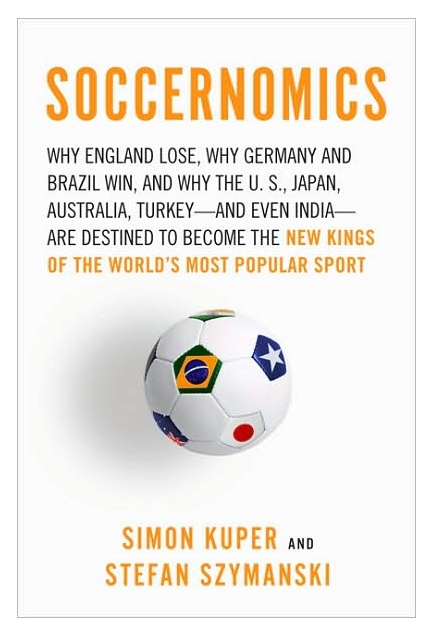
There's certainly a Moneyball aspect to this book, as the authors try to deconstruct a lot of the assumptions and common theories about the game (for instance, England is not nearly so much of an underachiever as its fans often believe) by applying more objective statistical analysis in favor of subjective analysis . The authors also attempt to dissect the factors that go into national success on the soccer pitch and examine what they tell us about countries that have embraced the game and those that have not.
I think soccer fans will appreciate the analysis of what goes into strong team performance, which nations' players tend to be good bargains for pro teams, and how the buying and selling of players operates (both how people think it operates and how it really appears to operate). Even those of us who don't really enjoy soccer may still be entertained by the discussion, as these two authors are quite engaging as writers.
It's not a flawless work, though. Some of the conclusions are rather obvious - discriminating against players based on race impairs top performance, for instance. In other cases, I wonder if the authors underestimate cultural factors when they make predictions about countries destined to rise or fall in the soccer world. Sure, the U.S. could be a future force in soccer (just like they could be a future force in hockey, sumo wrestling, or cricket), but the authors don't do enough in my opinion to explore why that may well not happen - namely, not enough people care about those sports at the highest levels. It's one thing to sign Junior up for soccer in the summer; it's another thing to buy season tickets to an MLS club.
I was surprised to read the extent to which soccer is not a big business ... or at least not a profitable business. The NFL and NBA roll around in money but soccer clubs do not appear to make much at all, and international events like the World Cup do little to stimulate economic progress (that's not really a surprise, given the history of the Olympics). Here too, though, it would have been interesting to read more about the follow-on gains from soccer - surely companies like Nike, Adidas, BSkyB, and the like make money from their involvement in the game.
All in all, it was interesting and informative book. Even if you are not interested in sports, this is an engaging book for how it addresses widely-held assumptions and teases out the truth through more rigorous fundamental analyses. Certainly there is value in that exercise - the more effective you are in challenging and testing your own assumptions, the better investor you will be.
Friday, June 25, 2010
Wait For A Sale On Nike
When is high-quality merchandise not so attractive? When you have to pay up to get it.
I am a fierce bargain hound, so much so that if I am routinely shopping at your store, you may just have a problem. But that innate cheapness serves me well in the stock market and I think investors who do not already own Nike (NYSE:NKE) should put this one on their "buy when it gets cheaper" watch list.
The Quarter That WasNike had a lukewarm quarter. Revenue was a little light relative to analyst hopes, but still grew about 8% to just over $5 billion. Within that number, footwear sales climbed more than 6% (to about $2.7 billion), while apparel jumped up 13% to $1.3 billion.
For the full column:
http://stocks.investopedia.
Subscribe to:
Posts (Atom)